









An Introduction to Narcissus Flowers
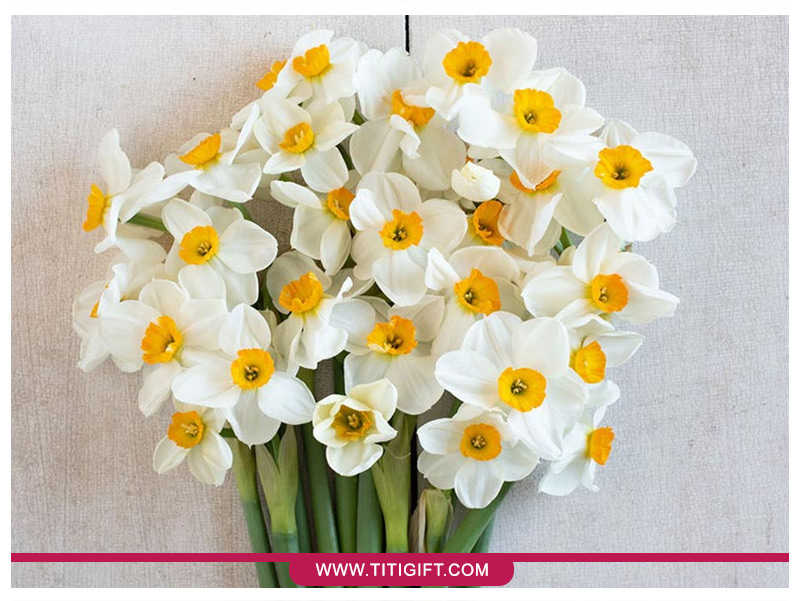
Scientific name: Narcissus
Family: Amaryllidaceae
Narcissus is a perennial bulbous plant. Due to its fragrant and beautiful flowers, it is cultivated in two ways: first, for the production of cut flowers, in which case large-flowered varieties are used, and second, for decorating gardens and parks, where any type can be cultivated. In the first case, Narcissus is often forced to flower early. Naturally, this plant blooms in the last days of the year and at the beginning of spring; however, its flowering season can be brought forward by several months.
The origin of Narcissus is Europe, North Africa, and parts of Asia. Its bulb is a true, tunicated bulb that flowers for several consecutive years and also becomes larger each year. The leaves are narrow and elongated, and the flowers consist of a six-part perianth (3 modified sepals and 3 petals) joined together at the base, with a trumpet or corona in the center that varies in length, color, and form. The flowers are borne singly or in clusters at the ends of flowering stems. Initially, the flower is enclosed within a spathe and later emerges from it.
There are 10 different types of Narcissus in the world, and various cultivars of each type have been developed and propagated to date. These types are classified according to the size of their flowers. The largest and biggest Narcissus flowers are trumpet-shaped and golden yellow. The varieties cultivated in Iran are different and probably belong to the Poeticus species.
Narcissus is propagated by planting seeds to obtain new varieties, and it is usually easily propagated through bulb division.
In late summer and autumn, before Narcissus begins to produce leaves, or when the leaves are still small, the bulbs are lifted from the soil and the offsets are separated from the main bulb; this process is easily carried out in Narcissus. At the new location, the bulbs should be planted in light, sandy soil. Narcissus is suitable for planting in rock gardens. Narcissus beds should be weeded, and this should be done in autumn, before the leaves begin to grow. In spring, weeding is also carried out in such a way that no damage is caused to the green Narcissus leaves. Growing Narcissus plants in gardens is interesting in this respect: in autumn, when other shrubs and plants shed their leaves, Narcissus begins its growth and development, maintains the freshness of the garden, and adds special beauty to the garden in winter and early spring. In Karaj, a double-flowered and very fragrant variety of Narcissus is cultivated, which is very early-flowering and blooms every year in December.
Narcissus is one of those flowers whose fragrance intoxicates people even from a distance. This beautiful flower, with its captivating fragrance and scent, is the flower of memories and recollections, and with its special delicacy and generosity, it has made the cold of winter more bearable since ancient times.
Shiraz Narcissus and Shahla Narcissus are the two main types of Narcissus in Iran. Shiraz Narcissus, which has a unique fragrance and scent, usually blooms from late autumn to mid-spring, while Shahla Narcissus, which has a large trumpet in the center and petals in shades of yellow, is a guest in gardens from late winter to early spring.
Requirements:
The Narcissus plant is resistant to cold and, compared with iris, is less sensitive to frost, but it is more sensitive than tulip and hyacinth. Its suitable soil is loamy soil rich in organic matter. It prefers soil with a slightly acidic PH (PH = 6-7), but lime must be added to highly acidic soils. Some species, such as N. tazetta and N. jonquilla , prefer alkaline soil. It should be planted in a sunny location. Its bulb is resistant to cold, and every 3 to 4 years, the bulb can be removed from the soil and the bulblets separated. The soil in which Narcissus is planted should be moist. However, if it receives too much water, it produces more leaves and does not flower. For flowering, it is better for the plant to experience a little dryness.
After flowering, to increase the size of the bulbs, a fertilizer with low nitrogen and high potassium should be used. Narcissus beds should be weeded, and this should be done in autumn, before the leaves begin to grow. In spring, weeds can also be removed in such a way that no damage is caused to the green Narcissus leaves.
Narcissus Flower Fragrance:
It has been said that the fragrance of Narcissus flowers has healing properties. Of course, this has not been scientifically proven, but there is no doubt that the fragrance of Narcissus is refreshing. These days, we often hear that the fragrance of Narcissus is beneficial for the respiratory tract and sinuses or that it prevents colds. It has even been mentioned that this fragrance can enter brain cells through the bloodstream.
The fact that pleasant fragrances can have a positive effect on brain function has been fully confirmed from a psychological perspective, but the details of how this happens have not yet been scientifically established. In the countries of Western Europe, Narcissus grows wild from eastern Spain and Portugal all the way to Germany and England. The Narcissus flower is recognized as the national flower of Wales.
```